

1-Tier vs 2-Tier vs 3-Tier vs 4-Tier HPL Lockers: Which Is Best for Your UAE Facility?
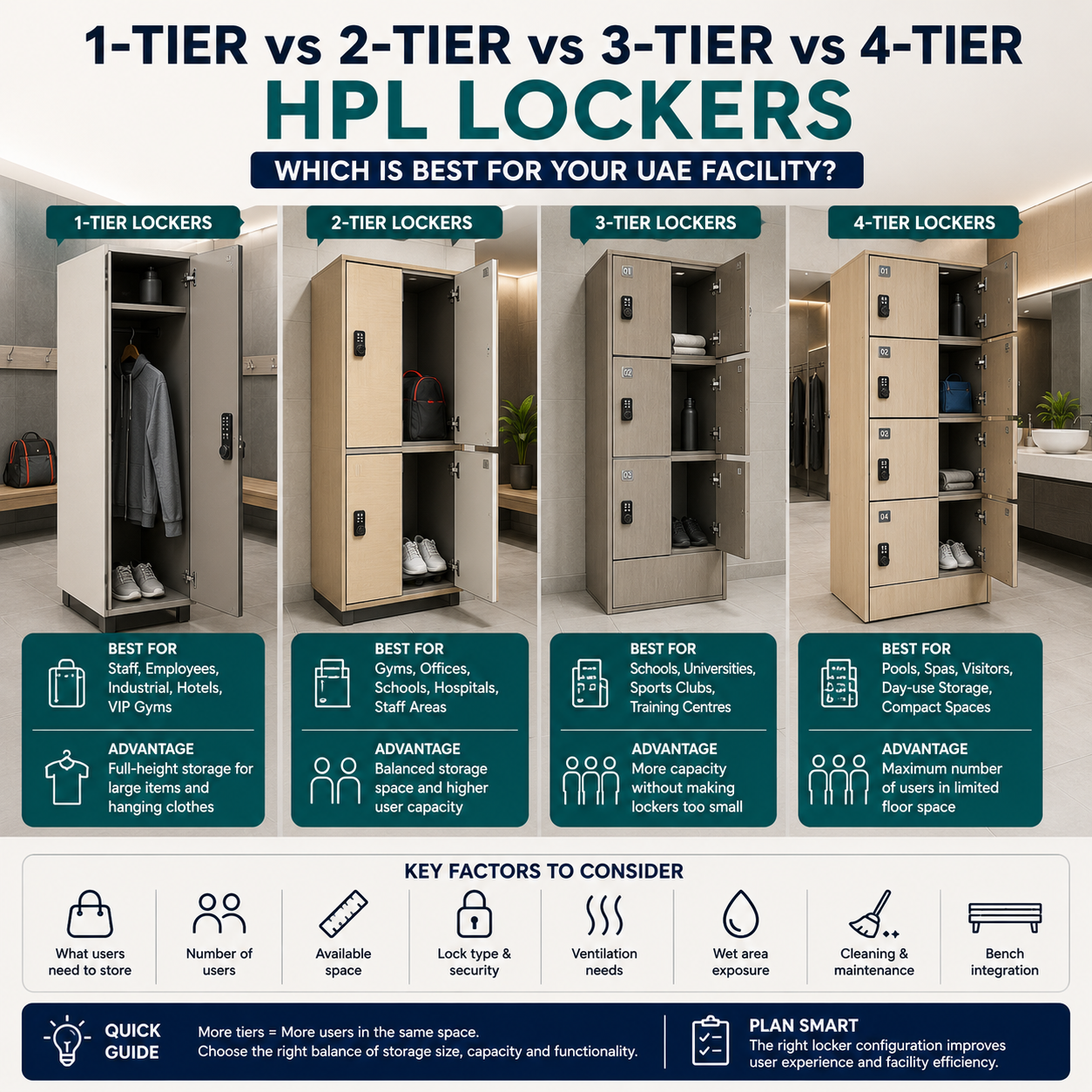
Choosing between 1-tier, 2-tier, 3-tier and 4-tier HPL lockers is not only a question of appearance. The correct configuration depends on what users need to store, how many people use the facility, the available floor space, the required level of security and the building’s cleaning routine.
A full-height locker may be ideal for employees who need to store uniforms and hanging garments, while a four-tier arrangement may be more efficient for visitors carrying only wallets, phones and small personal items. This guide compares the main HPL locker configurations in UAE to help gyms, schools, offices, hospitals, hotels, sports facilities and industrial sites select the right layout.
What Are HPL Locker Tiers?
A locker tier describes how many separate compartments are arranged vertically within one locker column.
- 1-tier locker: One full-height compartment
- 2-tier locker: Two compartments arranged vertically
- 3-tier locker: Three individual compartments per column
- 4-tier locker: Four compact compartments per column
Increasing the number of tiers increases the number of users served within the same floor area. However, each compartment becomes smaller. The best configuration therefore depends on the balance between storage volume and user capacity.
HPL Locker Configuration Comparison
| Locker type | Storage capacity | User capacity | Best for | Main advantage |
|---|---|---|---|---|
| 1-tier | Large | One user per column | Staff changing rooms, hotels, VIP gyms and industrial facilities | Full-length hanging and large-item storage |
| 2-tier | Medium to large | Two users per column | Gyms, offices, schools, hospitals and staff areas | Strong balance between storage space and capacity |
| 3-tier | Medium | Three users per column | Schools, universities, sports clubs and employee facilities | Efficient capacity without making compartments too small |
| 4-tier | Compact | Four users per column | Spas, pools, visitor areas, entertainment venues and day-use storage | Maximum locker quantity within limited floor space |
1-Tier HPL Lockers
What is a 1-tier locker?
A 1-tier locker provides one tall compartment from the upper section to the base of the locker. It normally offers the largest internal storage volume of all standard tier configurations.
What can users store?
Depending on the internal fittings, users may store uniforms, jackets, shoes, helmets, backpacks, sports equipment and other larger personal belongings.
Best applications for 1-tier lockers
- Industrial employee changing rooms
- Hotel and hospitality staff facilities
- Premium gym and VIP changing rooms
- Healthcare staff locker rooms
- Security and facility-management departments
- Locations where uniforms need to remain hanging
Main benefits
- Maximum individual storage space
- Can accommodate a hanging rail and internal shelf
- Suitable for uniforms and long garments
- Can include separate shoe or helmet storage
- Creates a premium and spacious user experience
Possible limitation
A full-height arrangement serves fewer people within the same wall length. It may therefore be unsuitable where the project needs a high locker count within a limited room.
2-Tier HPL Lockers
A 2-tier configuration divides one locker column into an upper and lower compartment. It is one of the most versatile choices because it provides a reasonable amount of storage while doubling user capacity compared with a full-height locker.
Best applications for 2-tier lockers
- Commercial gyms and fitness centres
- Schools and universities
- Corporate offices
- Hospitals and medical facilities
- Hotel staff changing rooms
- Sports clubs and training centres
Main benefits
- Good balance between locker size and user count
- Can hold a backpack, folded clothing, shoes and personal items
- Suitable for many employee and student applications
- Works well with key, keypad, padlock or RFID locking systems
- Can be combined with integrated changing-room benches
3-Tier HPL Lockers
Three-tier lockers provide three medium-sized compartments within each vertical column. They are useful where the facility needs a higher user capacity but each user still requires more storage than a compact valuables locker can provide.
Best applications for 3-tier lockers
- Schools and universities
- Training centres
- Sports academies
- Padel, football and indoor sports facilities
- Large staff changing rooms
- Employee amenity areas
Main benefits
- Serves three users within one locker column
- Offers better space efficiency than 1-tier and 2-tier systems
- Suitable for bags, books, folded clothing and personal items
- Works well in busy facilities with scheduled user groups
- Can be numbered and colour-coded by department or class
Planning consideration
The top and bottom compartments should remain comfortable to reach. The overall height and compartment distribution should be coordinated with the expected users, particularly in schools or facilities serving children.
4-Tier HPL Lockers
Four-tier lockers are designed for compact personal storage. They maximise the number of compartments available within the same floor area and are ideal where users do not need to store large garments or bulky equipment.
Best applications for 4-tier lockers
- Swimming pools and leisure centres
- Spas and wellness facilities
- Visitor and day-use storage areas
- Theme parks and entertainment venues
- Libraries and educational facilities
- Mobile phone and valuables storage
Main benefits
- Maximum number of users per locker bank
- Efficient use of narrow locker rooms
- Suitable for short-term visitor storage
- Can be paired with coin, token, digital or RFID locks
- Useful for separating departments or temporary user groups
Possible limitation
Four-tier compartments may not be suitable for jackets, full uniforms, large backpacks or sports equipment. The actual items users need to store should be confirmed before the layout is approved.
Which Locker Configuration Is Best for Each Facility?
| Facility | Recommended configuration | Reason |
|---|---|---|
| Commercial gym | 2-tier or 3-tier | Provides capacity while allowing storage for gym bags, footwear and clothing |
| VIP gym or health club | 1-tier or large 2-tier | Creates a more spacious, premium changing experience |
| Primary school | 2-tier or 3-tier | Useful for bags, books and personal items while maintaining accessible heights |
| University | 3-tier or 4-tier | Supports a larger student population and day-use storage |
| Corporate office | 2-tier | Offers practical storage for bags, helmets, footwear and personal belongings |
| Industrial changing room | 1-tier or 2-tier | Allows storage of uniforms, PPE, shoes and personal equipment |
| Hospital staff room | 1-tier or 2-tier | Supports uniforms, footwear and staff belongings |
| Spa or pool | 3-tier or 4-tier | Suitable for compact visitor storage and high user turnover |
| Hotel staff facility | 1-tier or 2-tier | Provides room for uniforms, shoes and personal items |
Factors to Consider Before Selecting Locker Tiers
- Identify what users will store: Confirm whether users need space for uniforms, helmets, backpacks, books, shoes or only small valuables.
- Calculate the number of users: Determine peak usage rather than relying only on the total number of employees or members.
- Measure the room accurately: Consider wall length, doorways, columns, benches, circulation space and emergency routes.
- Review the user profile: Locker heights and compartment access should suit adults, children, elderly users or mixed user groups.
- Choose the locking system: Key locks, hasp locks, digital keypads, RFID systems and networked smart locks have different management requirements.
- Plan ventilation: Sportswear, shoes and uniforms may require slots, louvres or another ventilation method.
- Consider wet-area exposure: Pool, spa and shower-adjacent lockers may need corrosion-resistant frames, stainless-steel fixings and raised bases.
- Allow for cleaning access: Raised bases, plinths and bench integration should be planned around the facility’s cleaning method.
- Review future expansion: Modular locker banks can make it easier to add capacity later.
What Size Should an HPL Locker Be?
Locker dimensions should be selected according to the intended storage items and project drawings. Royal Cubicles offers custom sizes as well as typical commercial formats.
The main HPL lockers UAE page currently lists typical overall sizes in the range of approximately 1800–1950 mm high, 300–400 mm wide and 450–500 mm deep, with project-specific customisation available.
Best Lock Types for Different Locker Configurations
| Lock type | Best use | Key benefit |
|---|---|---|
| Key-operated cam lock | Offices, schools and staff facilities | Simple and economical |
| Hasp and padlock | Schools, gyms and employee changing rooms | Users can manage their own padlocks |
| Mechanical combination lock | Gyms and shared facilities | No electronic system or physical key required |
| Digital keypad lock | Gyms, offices and hospitality | Flexible code-based access |
| RFID or proximity lock | Premium gyms, offices, hotels and smart facilities | Can integrate with access cards or wristbands |
| Coin or token lock | Pools, leisure venues and public facilities | Useful for temporary visitor storage |
Should HPL Lockers Include Benches?
Integrated or separate benches can improve comfort in gyms, staff changing rooms, sports facilities and industrial locker rooms. Bench design should allow safe circulation and should not obstruct locker doors or cleaning access.
Explore Royal Cubicles’ HPL benches and changing-room seating for coordinated locker-and-bench solutions.
Why HPL Is Used for Commercial Lockers
High Pressure Laminate is used in commercial interiors because it can provide a durable, decorative and easy-to-maintain surface when the correct grade and construction are selected. ISO 4586 provides the international classification framework for high-pressure decorative laminates.
Technical readers can review the official ISO 4586-1 overview for general information about HPL classification and specification.
For more background, read Royal Cubicles’ complete High Pressure Laminate guide .
Cleaning and Maintenance Tips
- Remove dust with a soft, non-abrasive cloth.
- Use mild detergent and clean water for routine cleaning.
- Avoid abrasive pads that may scratch decorative surfaces.
- Dry surfaces after cleaning, particularly around joints and hardware.
- Inspect hinges, locks and fixings periodically.
- Replace damaged hardware before it affects surrounding panels.
- Keep ventilation slots clear.
- Follow the laminate manufacturer’s maintenance instructions.
Formica’s official laminate care and maintenance guidance recommends gentle cleaning with a damp, non-abrasive cloth and mild detergent for ordinary surface care.
Common Locker Planning Mistakes
- Selecting four-tier lockers when users need to store large bags
- Choosing full-height lockers without confirming available user capacity
- Ignoring ventilation for wet clothing and footwear
- Placing benches too close to locker doors
- Using unsuitable hardware near pools or showers
- Failing to provide a master-key or emergency-override strategy
- Positioning upper compartments too high for the intended users
- Not accounting for skirting, columns or uneven floors
- Approving fabrication before confirming final site dimensions
Why Choose Royal Cubicles?
Royal Cubicles designs, supplies and installs custom HPL locker systems for gyms, schools, offices, hospitals, hotels, industrial sites and changing rooms across Dubai and the UAE.
Available options include:
- 1-tier, 2-tier, 3-tier and 4-tier configurations
- Custom dimensions and internal shelving
- Key, padlock, digital, RFID and smart locking systems
- Ventilated doors and raised wet-area bases
- Powder-coated steel or aluminium frames
- Integrated and standalone changing-room benches
- Custom colours, numbering and signage
- Site measurement, shop drawings and installation
Explore Royal Cubicles’ main HPL locker solutions , HPL toilet cubicles and contact the project team for layouts and quotations.
Frequently Asked Questions
Which HPL locker configuration is best for gyms?
Two-tier or three-tier HPL lockers are commonly suitable for gyms because they provide useful space for bags, clothing and footwear while serving more users than full-height lockers. Premium clubs may prefer one-tier lockers for additional storage.
Which locker tier is best for schools?
Two-tier and three-tier lockers are practical for many schools. The final choice should consider student age, bag size, books, available space and accessible reach heights.
What is the difference between 2-tier and 3-tier lockers?
A two-tier locker provides two larger compartments per column, while a three-tier locker provides three smaller compartments. Two-tier systems offer more individual storage, while three-tier systems increase user capacity.
Are 4-tier lockers suitable for changing rooms?
Four-tier lockers are suitable for compact day-use storage, spas, pools and visitor areas. They may not be large enough for full uniforms, jackets or bulky sports equipment.
Can different locker tiers be combined in one room?
Yes. A mixed layout can combine full-height lockers for uniforms, two-tier lockers for staff and compact lockers for valuables, provided the design remains visually consistent and allows safe circulation.
Can HPL locker sizes be customised?
Yes. HPL locker height, width, depth, number of tiers, internal shelves, ventilation, colours, hardware and locking systems can be customised according to the approved project requirements.
Which lock is best for HPL lockers?
The best lock depends on the facility. Padlock systems suit many schools, digital locks suit gyms and offices, RFID locks suit premium smart facilities, and coin or token locks suit temporary public storage.
Does Royal Cubicles supply HPL lockers across the UAE?
Yes. Royal Cubicles supplies custom HPL locker and changing-room solutions for projects across Dubai, Abu Dhabi, Sharjah, Ajman and other UAE locations.
Conclusion
The best HPL locker configuration depends on the items users need to store and the number of people the facility must serve. One-tier lockers provide maximum personal storage, two-tier lockers offer the best general balance, three-tier lockers improve capacity, and four-tier lockers are ideal for compact day-use storage.
Before approving a locker layout, confirm user needs, room measurements, lock type, ventilation, wet-area exposure and cleaning access.
Visit Royal Cubicles HPL Lockers UAE to request a custom locker layout and quotation.
